
The 2 most effective breathing methods to lower cortisol naturally
Cortisol is often referred to as the "stress hormone"—and for good reason: in stressful situations, our bodies release this glucocorticoid to mobilize energy. This is useful in the short term, but prolonged excess cortisol can be harmful to health (fatigue, sleep disorders, weight gain, anxiety).
How can you lower cortisol naturally and restore balance?
Among non-medicinal approaches, breathing plays a key role. In this article, we present two effective breathing techniques for naturally lowering cortisol: abdominal breathing andcoherent breathing. We will see how to combine them and why long, regular sessions maximize their long-term benefits.

1. Abdominal breathing: breathe through your stomach to lower cortisol levels.
Abdominal breathing—also known as diaphragmatic breathing or belly breathing—involves breathing deeply by inflating the abdomen (rather than the chest) as you inhale. This technique activates the diaphragm, a key muscle, and stimulates the vagus nerve, which triggers a relaxation response in the parasympathetic nervous system. The result: your heart rate slows down, your blood pressure drops, you feel calmer... and your body begins to reduce cortisol production. In other words, breathing slowly with your belly helps to lower cortisol physiologically.

Solid scientific research confirms these effects. For example, astudy published in Frontiers in Psychology (2017)observed that after 8 weeks of diaphragmatic breathing training (20 sessions of 30 minutes), healthy adults showed a significant decrease in salivary cortisol compared to a control group. This decrease in cortisol was accompanied by improved mood and increased attention in the participants. Similarly, a2019 systematic reviewconcluded that diaphragmatic breathing is effective in reducing physiological markers of stress, including respiratory rate and cortisol levels. In short, breathing from the belly for a few minutes a day triggers measurable relaxation mechanisms: it is a simple and natural way to lower cortisol and regain inner calm.

How to practice?
Abdominal breathing can be practiced anywhere, sitting or lying down:
-
Place one hand on your stomach and the other on your chest to feel the movement.
-
Breathe in slowly through your nose, allowing your belly to expand under your hand (while your chest remains almost motionless).
-
Exhale slowly through your mouth (or nose) while pulling your stomach in, as if you were deflating a balloon.
-
Take slow breaths, inhaling for 5 to 6 seconds and exhaling for 5 to 6 seconds. Focus on the movement of your abdomen.
Just a few minutes of this deep breathing is enough to activate a relaxation response. With regular practice, your body will become accustomed to breathing more deeply, which will help lower your baseline cortisol levels and better manage everyday stress.

2. coherent breathing 6 breaths per minute to calm stress and cortisol
coherent breathing a rhythmic breathing technique that aims to synchronize breathing with variations in heart rate (heart rate variability). In practical terms, this involves breathing at a regular rate of around 6 breaths per minute (for example, 4 seconds of inhalation and 6 seconds of exhalation). This particular rhythm (~0.1 Hz) maximizes the natural oscillation of the heart and strongly activates the vagus nerve, inducing a state of deep physiological calm. coherent breathing is known to reduce perceived stress, improve emotional balance, and, as a result, help lower cortisol levels over the long term.
Once again, science supports these benefits. Doctors and researchers have measured the tangible effects of coherent breathing our stress hormones. For example, aclinical study by the Institute of HeartMathreported that after one month of daily practice of coherent breathing exercises coherent breathing combined with emotion management techniques), adults saw their cortisol levels drop by an average of 23%. Interestingly, the same study noted a doubling of DHEA levels, an anti-stress hormone often referred to as the "youth hormone," which illustrates how coherent breathing a more favorable hormonal balance (less cortisol, more DHEA). Other studies confirm the positive impact of coherent breathing cortisol. For example, ameta-analysis published in 2023mentions that in slow breathing exercises such as coherent breathing, participants' cortisol levels were significantly lower compared to control groups not practicing these exercises. In short, learning to deliberately slow down your breathing and synchronize your heart and breathing helps your physiology counteract excess cortisol.

Long sessions: more measurable benefits on cortisol
It is generally recommended to practice coherent breathing minutes, 3 times a day (the famous 365 rule: 3 times/day, 6 breaths/minute, 5 minutes) to reap the benefits. These short sessions are excellent for quickly relieving stress. However, recent findings suggest that extending the duration of sessions can optimize hormonal and nervous system effects in the long term. In fact, a2023 studyconducted by Mather and Lehrer showed that daily sessions of 20 to 40 minutes of coherent breathing, over five weeks, led to a significant remodeling of the neural circuits between the prefrontal cortex and the amygdala (the areas of the brain that manage our emotions and stress response). In other words, practicing for longer periods of time induces profound changes that make the brain and body more resistant to stress.
So, to lower cortisol levels in a sustainable way, it may be a good idea to plan for at least 15 to 20 consecutive minutes of coherent breathing your sessions (rather than brief, sporadic breaths). You can of course start with 5 minutes if you are a beginner, but try to gradually increase the duration: for example, 10 minutes, then 15 minutes... Long sessions (15-40 min) promote more complete relaxation, cortisol stabilization, and better long-term resilience to stress. Feel free to adapt the time of day: many people enjoy a 20-minute session in the evening to release accumulated cortisol and sleep better, or in the morning to start the day with serenity.
3. Combine abdominal breathing and coherent breathing maximize the effects.
Although they are presented separately, these two methods are not mutually exclusive—on the contrary, they complement each other perfectly. In fact, coherent breathing best practiced using abdominal breathing: it is by breathing slowly through the belly that we achieve the greatest respiratory amplitude and the strongest vagal activation. By combining the two, you reap the benefits: the coherent rhythm (6 breaths per minute) optimizes heart rate variability and sends a signal of calm to the brain, while deep abdominal breathing ensures maximum oxygenation and physical relaxation (thanks to the diaphragm), which slows down cortisol secretion.

In practice, starting a coherent breathing session coherent breathing a few slow abdominal breaths helps to "unblock" the diaphragm. Then continue in the same way, counting ~5-6 seconds on the inhale and ~5-6 seconds on the exhale, so as to reach a rhythm of 6 cycles/minute. Focus on the movement of your belly and possibly on the sound of your breath. You can use a visual or audio guide (there are apps and videos available) to keep the right tempo—we offer an alternative below. After about ten minutes, the magic happens: you feel your heart rate synchronize with your breathing, your mind clear, and a state of calm settle in. This is a sign that you are coherent breathing diaphragmatically. Maintain this as long as possible (15, 20, 30 minutes, etc.) to anchor this state. With daily practice of this breathing technique, you will train your body to better regulate its cortisol and remain calmer in the face of stress.

4. The Neoflo breathing belt: your ally for regular exercise
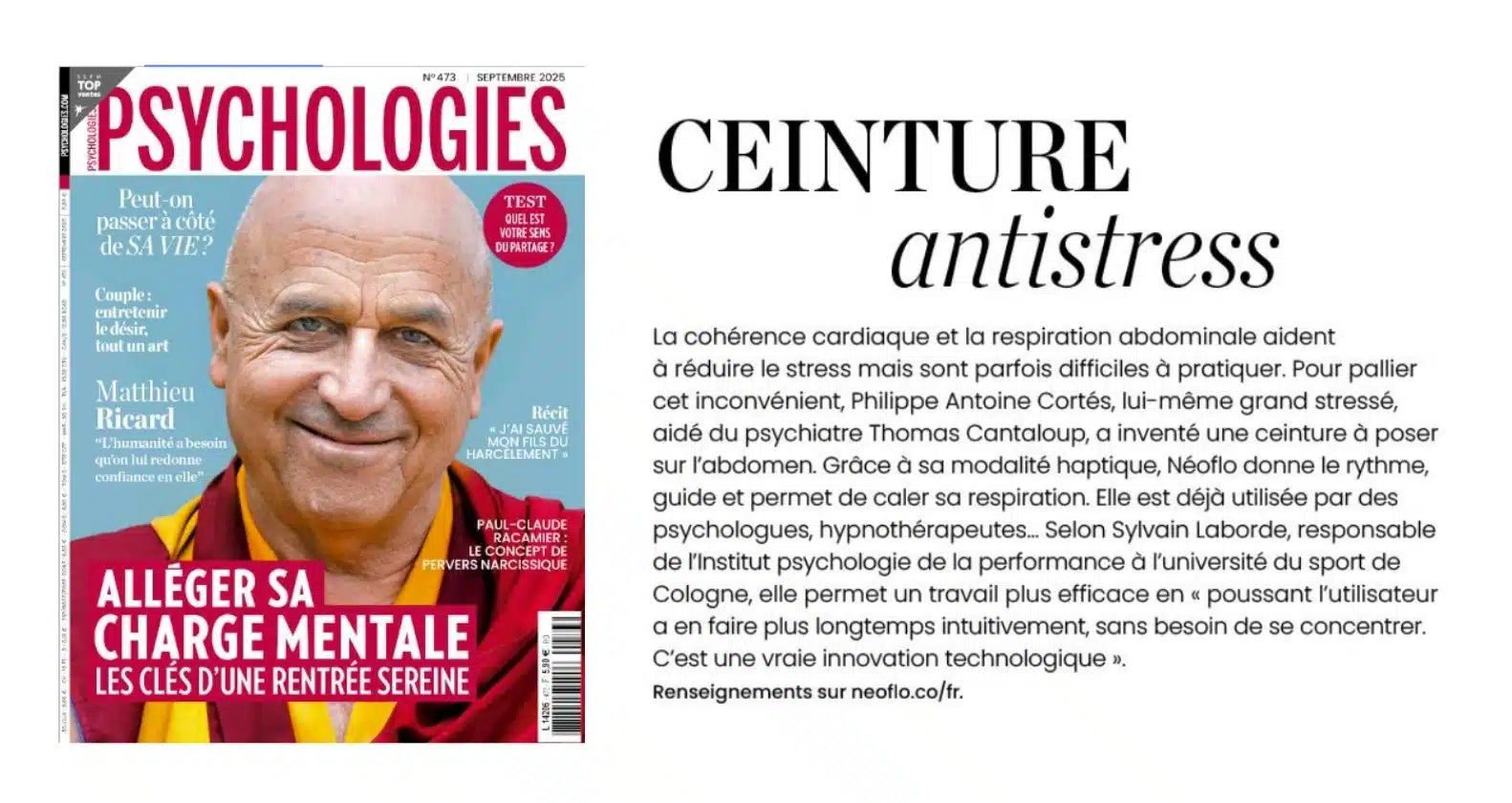
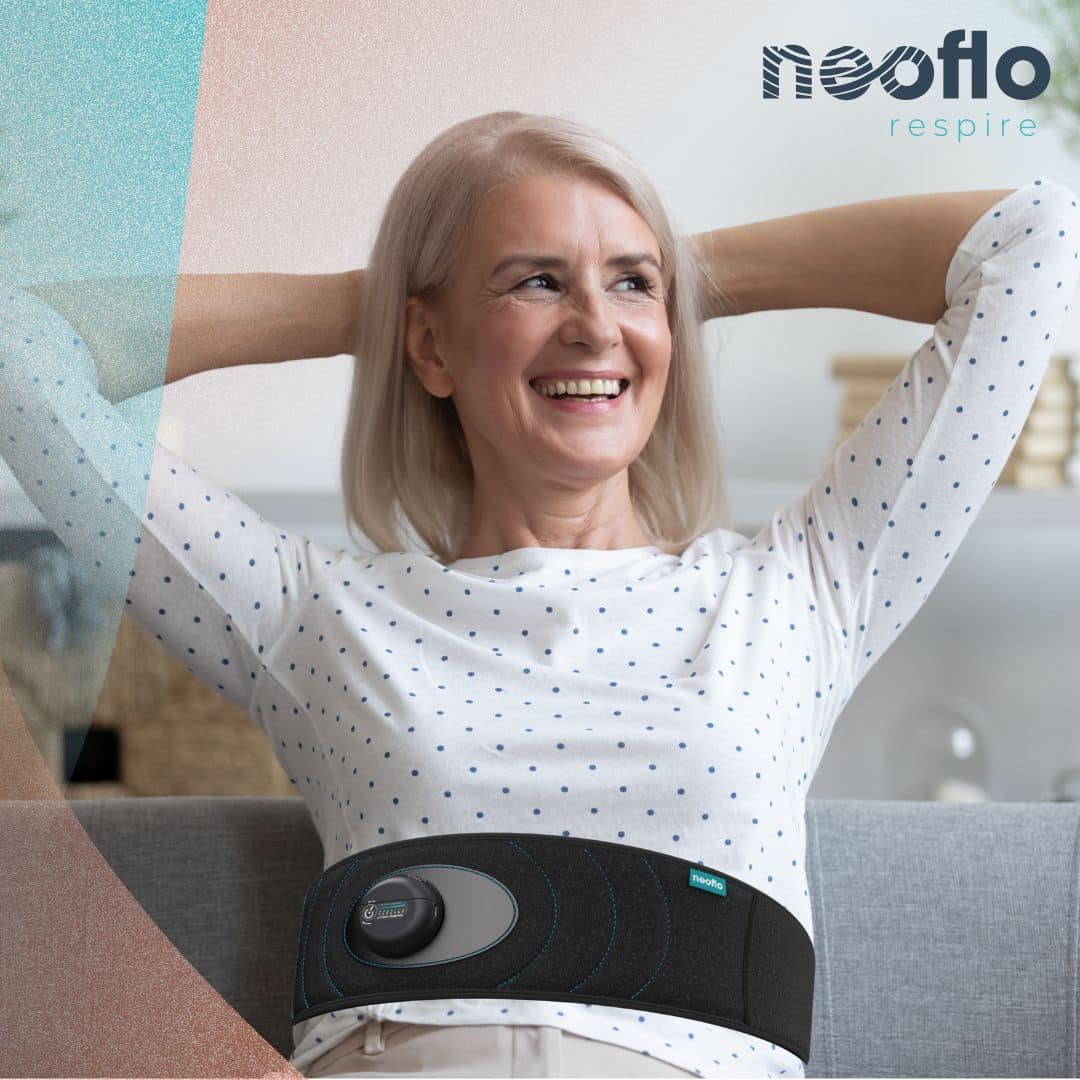
While it can sometimes be difficult to motivate yourself or maintain the right pace without distractions, there are tools available to help you. The Neoflo breathing belt is an innovative device designed to facilitate coherent breathing abdominal breathing. It is a smart belt that fits around your waist and guides your breathing with gentle vibrations, without the need to look at a screen or count in your head. This offers several advantages:
-
Intuitive guidance: synchronized tactile vibrations tell you when to inhale and exhale, automatically keeping you at the ideal rhythm (~6 breaths/minute) without any effort to concentrate.
-
Easier to practice: you can do sessions lasting 20 minutes or more without losing focus, which helps you achieve the optimal duration for effectively lowering cortisol levels over the long term.
-
Flexible use: the belt is discreet and silent, so you can use it at any time of day—during a break, in front of the TV, at bedtime—to easily integrate your breathing exercises into your daily routine.
By guiding smooth, abdominal, and consistent breathing, the Neoflo belt helps you fully harness the superpowers of your breath. You activate your vagus nerve more easily, which promotes relaxation and reduces cortisol levels over the course of your sessions. What's more, following a regular program becomes simple and enjoyable, much like having a personal breathing coach. Many users find that with this tool, coherent breathing a daily reflex—and their testimonials report better stress control, improved sleep, and a renewed sense of inner calm.
In conclusion, breathing to lower cortisol is something anyone can do. Abdominal breathing and coherent breathing techniques coherent breathing a natural, scientific, and accessible approach to regulating our stress hormone. By combining these methods and practicing for long enough sessions, we can effectively reduce cortisol while improving our overall well-being. And with aids such as theNeoflo breathing belt, it becomes even easier to stick to it on a daily basis. Take a few minutes each day to breathe consciously through your belly and synchronize your heart: your body and mind will thank you, with less stress, balanced cortisol, and optimized long-term health.

Sources:
-
Ma X. et al. (2017). The Effect of Diaphragmatic Breathing on Attention, Negative Affect and Stress in Healthy Adults. Frontiers in Psychology, 8:874frontiersin.orgfrontiersin.org.
-
Hopper S.I. et al. (2019). Effectiveness of diaphragmatic breathing for reducing physiological and psychological stress in adults: a quantitative systematic review. JBI Database System Rev Implement Rep, 17(9), 1855-1876pubmed.ncbi.nlm.nih.govpubmed.ncbi.nlm.nih.gov.
-
McCraty R. et al. (1998). Impact of a new emotional self-management program on stress, emotions, heart rate variability, DHEA, and cortisol. Integrative Physiol & Behav Sci, 33(2), 151-170pubmed.ncbi.nlm.nih.gov.
-
Healthy Mind (2021). How does cardiac coherence relieve stress? (healthymind.fr)healthymind.fr.
-
Mather & Lehrer et al. (2023). Study on coherent breathing minutes and neural connections (reference in Journal of Clinical Medicine, 2023)neoflo.co